


Getting a boat license in BC means obtaining a Pleasure Craft Operator Card (PCOC), the official proof of competency required by Transport Canada for anyone operating a motorized vessel. The PCOC applies to power-driven boats with engines over 10 horsepower, and both BC residents and out-of-province visitors must carry one to operate legally. Whether you’re planning a weekend on Okanagan Lake or trailering your boat from Alberta, understanding the difference between the PCOC and the Pleasure Craft Licence (PCL) is the single most important thing you can do before hitting the water.
How to get a boat license in BC: steps, costs, and timing
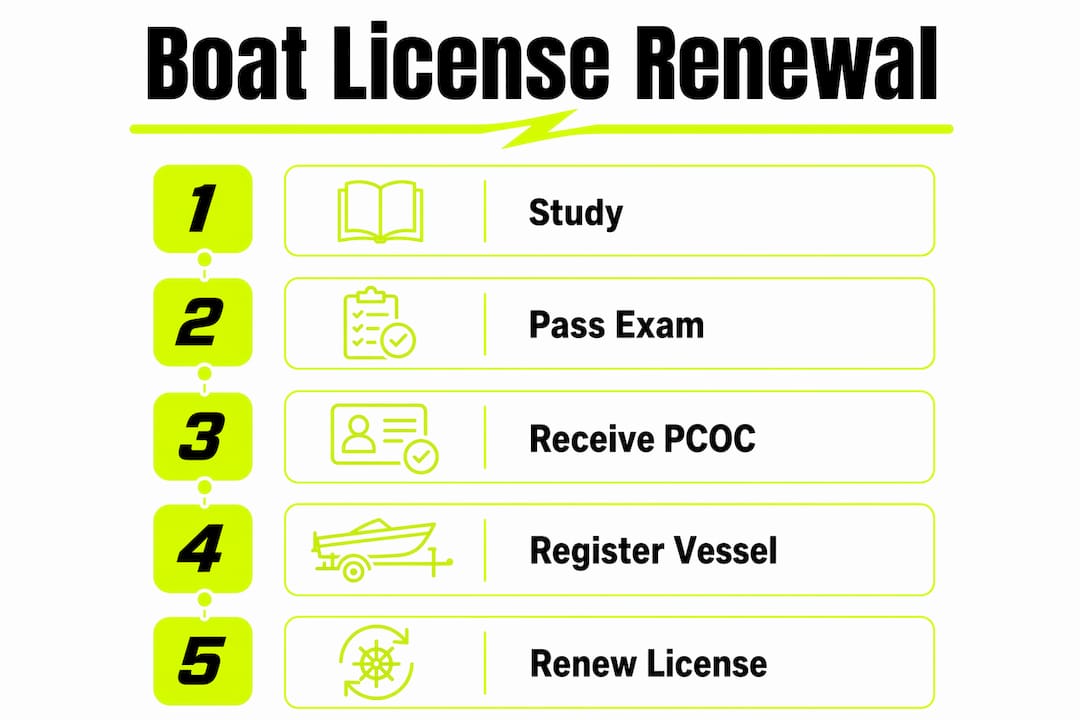
The PCOC process is straightforward. You complete a Transport Canada-accredited course, pass a 50-question exam with a 75% passing score, and print your temporary card immediately. The whole process takes 3–5 hours from start to finish.
Here is the step-by-step breakdown:
- Choose an accredited course. Transport Canada approves both online and in-person courses. Online options let you study at your own pace, which works well for Albertans planning a BC trip.
- Study the material. Plan for roughly 3 hours of study time. The course covers right-of-way rules, emergency response, and required safety equipment.
- Pass the exam. The 50-question exam requires a 75% score to pass. You can retake it if needed.
- Print your temporary card. Once you pass, you print a temporary PCOC immediately. This card is legally valid right away.
- Receive your permanent card. The physical card arrives by mail within 2–6 weeks.
Costs run approximately $30–$70 CAD depending on the provider. That is a one-time fee. The PCOC is valid for life and never requires renewal. That single fact surprises most first-time boaters.
Pro Tip: Print two copies of your temporary PCOC. Keep one on the boat and one in your vehicle. Officers can ask for it at the dock before you even launch.
There is no minimum age to obtain a PCOC, but operators under 16 face horsepower restrictions regardless of whether they hold the card. Parents bringing teenagers on BC water should review those limits before departure.
What is the Pleasure Craft Licence and what changed in 2026?
The Pleasure Craft Licence (PCL) is a license for the boat itself, not the operator. Any pleasure craft with a motor of 10 horsepower or greater requires a PCL. This is where most boaters get confused: the PCOC proves you can operate a vessel, while the PCL proves the vessel is registered and identified.
As of december 31, 2025, Transport Canada replaced the old lifetime and 10-year licence cycles with a 5-year renewal requirement. The renewal fee is $24. That change affects every motorized pleasure craft owner in Canada.
| PCL Detail | Current Rule |
|---|---|
| Validity period | 5 years (effective Dec 31, 2025) |
| Renewal fee | $24 CAD |
| Info update deadline | Within 30 days of any change |
| New owner temp permit | Valid for 30 days during transfer |
| Sailboats over 6 meters | PCL required starting Dec 31, 2027 |
The government’s reason for the 5-year cycle is practical. Derelict vessels cost an average of $14,000 per boat to remove from waterways. Regular renewals help authorities track ownership and reduce abandoned boats.
Pro Tip: Set a calendar reminder 60 days before your PCL expiry date. Renewing late can result in fines, and operating with an expired PCL is a compliance violation even if your PCOC is current.
Owners must update contact information with Transport Canada within 30 days of any change. If you buy a used boat, you can operate it under a temporary permit for 30 days while the transfer processes. After that, the new PCL must be in place. Starting december 31, 2027, wind-powered craft over 6 meters will also require a PCL, closing a long-standing gap for non-motorized sailboats.
Do you need a boat license in BC if you’re visiting from Alberta?
Alberta boaters visiting BC waters get a specific exemption. Non-residents are exempt from the PCOC requirement if they operate their vessel for less than 45 consecutive days in Canadian waters. That covers most vacation trips and long weekends on Okanagan Lake.
The exemption comes with conditions. You must carry:
- Proof of residence showing you are a non-Canadian resident or a Canadian visiting from another province under the 45-day window.
- Equivalent competency proof if your home jurisdiction issues a boating certificate. An Alberta boating license or equivalent card satisfies this requirement.
- Vessel documentation for the boat you are operating, including its PCL if it is a Canadian-registered craft.
Rental boats operate under a different rule entirely. Rental companies can provide a safety checklist and briefing that serves as temporary proof of competency. This means you can legally operate a rental boat in BC without a PCOC, as long as the rental company completes the required safety orientation. That temporary proof is valid only for the duration of the rental.
The 45-day exemption disappears the moment you own a Canadian-registered vessel. If you purchase a boat in BC or register one in Canada, you need a PCOC regardless of where you live. Exceeding 45 consecutive days of operation also triggers the full requirement.
Staying compliant on BC waters: what to carry and track
Compliance on BC waters comes down to documentation and deadlines. Most boaters who get fined are not reckless. They simply forgot to renew, update an address, or transfer a licence after buying a used boat.
Here is what every boater should keep current:
- Carry your PCOC on board at all times. Officers can request it during any water patrol stop. A digital copy on your phone is not an accepted substitute in all situations. Carry the physical card or a printed temporary.
- Display your PCL number on the bow. The PCL number must appear on both sides of the bow in block letters at least 7.5 centimeters tall. This is a federal requirement, not a suggestion.
- Renew your PCL before the 5-year expiry. The new renewal cycle means every motorized boat owner now has a hard deadline. Mark it early.
- Update your contact info within 30 days of any address or ownership change. Failing to do so is a separate compliance violation from having an expired PCL.
- Transfer the PCL promptly when buying or selling. The 30-day temporary permit for new owners is a grace period, not a permanent solution.
- Check Transport Canada’s website annually for regulatory updates. The 2026 changes caught many long-time boaters off guard.
Pro Tip: Take a photo of your PCL and PCOC and store them in a cloud folder labeled “Boat Docs.” If your wallet goes overboard, you still have the information needed to prove compliance to an officer.
For anyone planning a boating adventure in Kelowna, checking your documentation before you leave Alberta saves time and avoids surprises at the launch ramp. BC Conservation Officers do conduct water patrols, particularly during peak summer weekends on Okanagan Lake.
Key Takeaways
The PCOC and PCL are two separate legal requirements in BC: one licenses the operator for life, and the other licenses the vessel every 5 years.
| Point | Details |
|---|---|
| PCOC is lifelong | Pass the 75% exam once and your operator card never expires or requires renewal. |
| PCL renews every 5 years | All motorized pleasure craft owners must renew their vessel licence for $24 starting Dec 31, 2025. |
| Alberta visitors get 45 days | Non-residents can operate in BC waters without a PCOC for up to 45 consecutive days. |
| Rental boats have a workaround | A rental company safety briefing and checklist substitutes for a PCOC during the rental period. |
| Update info within 30 days | Failing to update ownership or contact details with Transport Canada triggers separate fines. |
The confusion that costs boaters the most
Every summer, boaters from Alberta pull into Kelowna thinking they have everything covered. They have their PCOC. They have their boat. What they often do not have is a current PCL, because they assumed the old lifetime licence was still valid.
That assumption is now wrong. The 5-year renewal rule changed everything as of december 31, 2025. I have seen boaters with 20 years of experience on the water get caught off guard by this. The lifetime PCL they got in 2010 is no longer valid. They need to renew, pay the $24, and update their records.
The other mistake I see constantly is treating the PCOC as just paperwork. It is not. The course covers right-of-way rules, emergency response, and equipment requirements that genuinely reduce accidents on busy waterways like Okanagan Lake. Boaters who take the material seriously are better operators. That is not a marketing line. It is what the safety education content is designed to produce.
My honest advice: get your PCOC before you need it, not the morning you plan to launch. And check your PCL expiry date today. If you are buying a used boat, confirm the transfer is complete before the 30-day temporary permit runs out. These are small tasks that prevent large headaches.
— Adrenaline
Ready to get on the water in Kelowna?
Once your PCOC is sorted and your vessel documentation is current, Okanagan Lake is waiting. Adrenaline4rental operates out of Kelowna and offers pontoon boat rentals, wake boats, and jet skis for all experience levels. With over 600 completed rentals and nearly 200 five-star Google reviews, Adrenaline4rental is the go-to choice for Alberta visitors and BC locals alike.
Rental guests who do not yet have a PCOC can still get on the water legally. Adrenaline4rental provides the required safety briefing and checklist, which serves as temporary proof of competency for the rental period. Check out the full fleet and booking options and plan your Kelowna trip with confidence. If you want to know what to expect before you arrive, the Okanagan Lake rental guide covers everything from launch ramps to lake conditions.
FAQ
What is a boat license in BC called?
The official term is the Pleasure Craft Operator Card (PCOC). It is issued by Transport Canada and proves you have passed a federally approved boating safety exam.
How long does it take to get a PCOC in BC?
The full process takes 3–5 hours. You study, pass a 50-question exam with a 75% score, and print a temporary card immediately. The permanent card arrives by mail within 2–6 weeks.
Do you need a boat license in BC as a visitor from Alberta?
Non-residents are exempt from the PCOC for up to 45 consecutive days of operation. You must carry proof of residence and any equivalent boating certification from your home province.
What is the difference between a PCOC and a PCL?
The PCOC licenses the operator and is valid for life. The PCL licenses the vessel, applies to any motorized boat with 10 horsepower or more, and now requires renewal every 5 years with a $24 fee.
Can you rent a boat in BC without a PCOC?
Yes. Rental companies can provide a safety checklist and briefing that acts as temporary proof of competency for the rental period. This applies to rentals from operators like Adrenaline4rental in Kelowna.
Recommended
- The Ultimate Guide to Renting a Boat in Kelowna – Adrenaline 4 Rental
- How to Throw the Best Boat Party in Kelowna: A Complete Guide – Adrenaline 4 Rental
- The Ultimate Kelowna Bachelor & Bachelorette Party on the Water (2026 – Adrenaline 4 Rental
- Ultimate Okanagan Lake Boat Rental Guide 2025 | Pontoon, Wake, Jet Ski – Adrenaline 4 Rental